It is a master data management tool for financial and analytical view of data presentation from multi dimensional sources. This course covers the fundamental of Hyperion DRM and focuses on topics of hierarchy views, nodes, compare data wit…
4.8 · Rated by learners Certificate of completion
Duration
20 Hours
Mode
Live + Recorded
Level
Beginner → Pro
Language
English / Hindi
AI practice, included with this course
Rehearse the interview and test yourself before the real thing.
Available in your student dashboard as soon as you enrol —
no extra charge, nothing to install.
Course overview
About the Oracle Data Relationship Management DRM program.
It is a master data management tool for financial and analytical view of data presentation from multi dimensional sources. This course covers the fundamental of Hyperion DRM and focuses on topics of hierarchy views, nodes, compare data with query building and more...Describe Data Relationship Management concepts and terminology, Navigate the information Relationship Management interface, Edit versions and hierarchies, Describe information Relationship Management design, produce information Relationship Management applications.
Why learn with BISP
Trusted by professionals across 30+ countries.
Industry trainers
Certified consultants with 12+ years of real project experience.
Hands-on practice
Real-time scenarios & live project modules, not just slides.
Placement support
Resume building, mock interviews & job referrals.
Certification
BISP certificate + full guidance for official exams.
Course curriculum
Designed by real-time industry professionals around current job roles.
In this course our experts will be going to teach, how to create Hierarchy Groups, XML Exports, Imports, Business cycle, master asset, versions, node. Including copy, run, export commands, deleting exports and more. After completion of course students have a deep understanding and confidence over concept. Its a 100% hands-on live training with real time professional expert, candidates work with various real-time scenario and application
02Product Orientation6 topics
About Data Relationship Management
Data Relationship Management DRM Architecture
Implementation Process for Data Relationship Management Applications
Audiences for Data Relationship Management
Connecting to DRM Applications with Web Client
Navigating Web Client
03Working with Versions and Hierarchies6 topics
Working with Versions
Creating, Copying, backing Up, and Restoring Versions
Version Variables
Working with Hierarchies
Creating, Opening, and Deleting Hierarchies
Implementation Considerations
04Working with Nodes8 topics
Creating Nodes
Adding, Deleting, Removing, and Inserting Nodes
Viewing Orphan Nodes
Copying, Moving, and Ordering Nodes
Creating Shared Nodes
Viewing and Editing Properties
Domain Membership for Nodes
Implementation Considerations
05Defining Properties8 topics
About Custom Properties
Configuring Defined Properties
Configuring List Values
Configuring Lookup Values
Configuring Inheriting Properties
Assigning Controlling Hierarchies to Global Inheriting Properties
Creating Property Categories
Loading Metadata with the Migration Utility
06Importing Data6 topics
About Importing Data
Importing from Files
Importing from Database Tables
Opening, Copying, and Deleting Imports
Creating Imports
Running Imports
07Querying and Comparing Data4 topics
Searching for Nodes
Creating Queries
Creating Compares
Working with Query and Compare Results
08Updating Data with Action Scripts7 topics
About Action Scripts
Creating Flat Files for Action Scripts
Loading Action Scripts from Flat Files
Running Action Scripts and Reviewing Results
Downloading Action Script Results
Automating Version Changes with Action Scripts from Transaction Logs
Modeling Nodes by Using Action Scripts
09Blending Versions4 topics
About Blending Versions
Opening, Copying, and Deleting Blenders
Creating Blenders
Running Blenders
10Creating Derived Properties8 topics
About Derived Properties
Derived Properties Using Formulas
Formula Syntax
Creating Derived Properties Using Formulas
Testing Formulas
Derived Properties Using Scripts
Script Syntax
Creating Scripts
11Validating Data8 topics
About Validations
Creating Validations
Validations Using Scripts
Assigning Validations to Versions, Hierarchies, and Nodes
Running Batch Validations
Attaching Batch Validation to Exports
Working with Batch Validation Results
Editing and Deleting Validations
12Setting Up Node Types7 topics
About Node Types
Process for Setting Up Node Types
Creating, Editing, and Deleting Glyphs
Creating, Editing, and Deleting Node Types
Assigning Node Types to Nodes
Configuring Hierarchy Node Type Property Values
Troubleshooting Node Type Assignments
13Exporting Data6 topics
About Exporting Data
About Export Types
Opening, Copying, and Deleting Exports
Creating Exports
Running Exports
Creating and Running Export Books
14Managing Security7 topics
Security Levels
Managing User Security
Managing Access to Nodes
Interactive and Workflow Node Access Groups
Assigning Access to Property Categories
Assigning Access to Metadata Objects
Granting Anonymous Access
15Configuring Governance Workflows8 topics
About Data Governance
Governance Workflow Objects
Workflow Tasks
Workflow Models
Working wih Requests
Navigating the Worklist
Request Lifecycle
Alerts and Notifications
16Analyzing Data Changes4 topics
Querying and Viewing Transaction History
Downloading Transaction History
Analyzing Data Changes
Creating As-Of Versions
17Class Delivery1 topics
Live Interactive classes with expert
Delivery Methodology
We are using an experiential delivering methodology that blends theoretical concepts with hands-on practical learning to ensure a holistic understanding of the subject or course.
Course details
Who it is for, what you need, and how it is delivered.
Who should learn Oracle Data Relationship Management DRM?
Software Developers
Business Managers
Finance Managers
Prerequisites
DRM is a data management tool for financial and analytical view of data presentation from multi dimensional sources.
Knowledge of finance
Knowledge of Reporting
Delivery methodology
We are using an experiential delivering methodology that blends theoretical concepts with hands-on practical learning to ensure a holistic understanding of the subject or course.
Class delivery
Live Interactive classes with expert
Certificate of completion
Earn an industry-recognised BISP Trainings certificate when you finish the course.
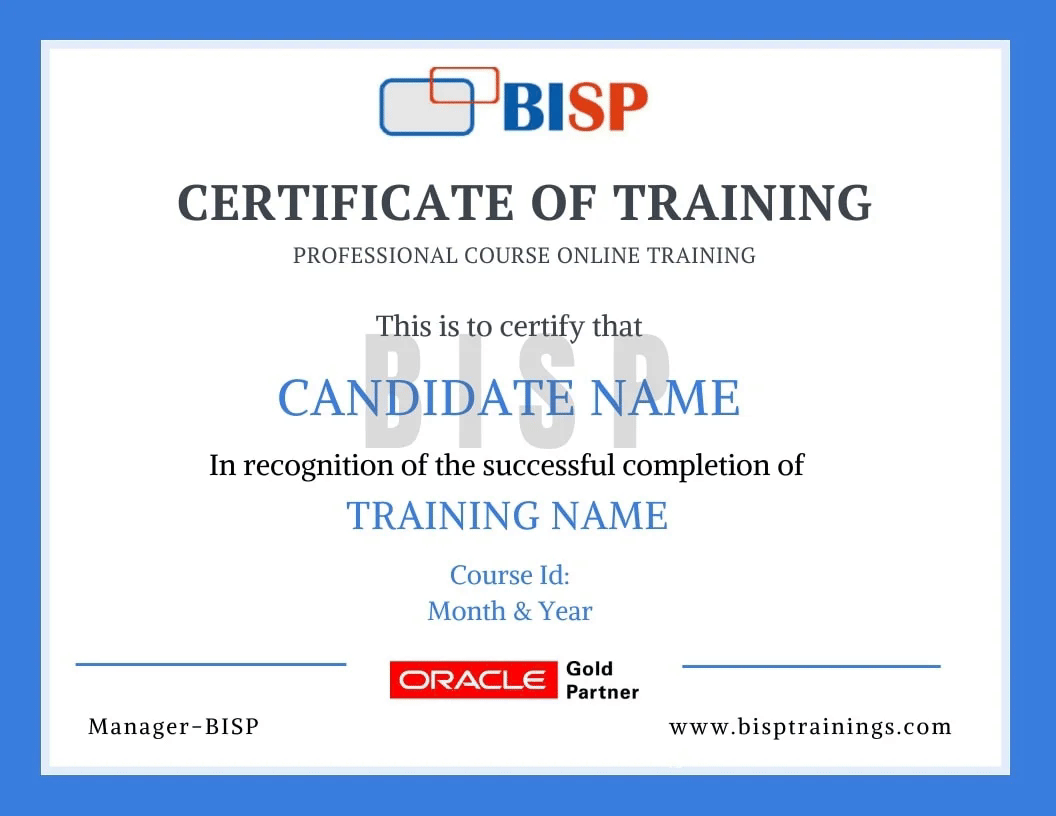
Verifiable certificate with a unique ID
Shareable on LinkedIn & your resume
Recognised by our hiring partners
Frequently asked questions
Everything you need before you enroll.
Can I attend a demo session before enrollment?
Yes. You may attend a demo class before enrollment for training quality evaluation, and interact one-to-one with the trainer for any specific requirement.
Can you schedule training as per my availability?
Yes. We discuss it with the trainer and schedule the training at a convenient time for you.
What if I miss a class?
You get the recorded session. You may also retake the whole training multiple times within a 6-month period with the same trainer.
Is there live project training?
Yes. The curriculum includes real-time scenarios and live project modules, with the trainer explaining every topic end-to-end.
How can I pay for the course?
Enroll securely via the payment gateway on this page using card, UPI or net-banking. EMI options are available.
More queries?
Call us at +91 769-409-5404 & +1 678-701-4914, or write to support@bisptrainings.com.